
🔹 Types of Agitators Used in Reactors
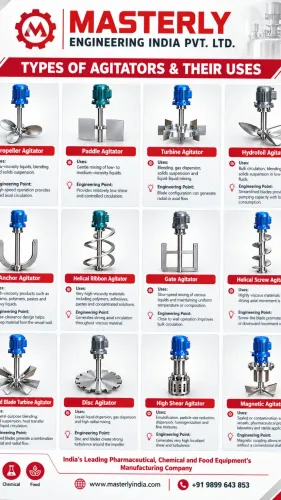
1. Propeller Agitator
- Flow: Axial flow (top to bottom).
- Use: Low-viscosity liquids, blending, mixing, heat transfer.
- Industry: Chemical, beverages, fermentation.
2. Turbine Agitator
- Flow: Radial flow, high turbulence.
- Variants: Flat-blade, pitched-blade turbine.
- Use: Gas–liquid reactions, solid suspensions, emulsions.
- Industry: Bioreactors, fermentation, chemical processes.
3. Anchor Agitator
- Flow: Sweeps vessel walls, prevents sedimentation.
- Use: High-viscosity liquids, pastes, creams, polymers.
- Industry: Food, cosmetics, resins, adhesives.
4. Paddle Agitator
- Flow: Gentle radial flow.
- Use: Mixing viscous fluids, slurry handling.
- Industry: Paints, wastewater treatment, chemical.
5. Helical / Ribbon Agitator
- Flow: Axial and radial combined, moves material from top to bottom.
- Use: Very viscous materials (gels, slurries, dough, polymers).
- Industry: Food, chemical, pharmaceuticals.
6. Saw-tooth Disc (High-Shear Agitator)
- Flow: Strong shear, dispersive mixing.
- Use: Breaking agglomerates, emulsification, dispersion of solids in liquid.
- Industry: Paints, inks, coatings, emulsions, pharma.
7. Marine Propeller
- Flow: Axial circulation.
- Use: Simple blending, suspension of solids in liquids.
- Industry: Fermentation, water treatment.
✅ Summary:
- Low viscosity reactors → Propeller, Marine propeller.
- Moderate viscosity & dispersion reactors → Turbine, Paddle.
- High viscosity reactors → Anchor, Helical/Ribbon.
- High shear reactors → Saw-tooth disc.
Keywords