For protein supplement powder, choosing the correct mixer depends mainly on powder characteristics, batch size, bulk density, formulation, and required blending uniformity. For Masterly Engineering, I would generally recommend an Octagonal Blender or Ribbon Blender, depending on the formulation.
1. First check the powder characteristics
ParameterWhy it mattersBulk densityDetermines actual volume requiredParticle sizeFine powders can segregate or form dustMoistureHigh moisture can cause sticking/lumpsFlowabilityPoor-flowing powders need stronger mixingCohesivenessDetermines whether gentle tumbling is sufficientIngredientsProtein, sugar, vitamins, minerals, flavours etc. behave differentlyHeat sensitivityImportant for whey/protein and flavours
2. Select the mixer
A. Octagonal Blender – usually the best choice for protein premixes
Recommended when:
- Whey/protein powder + sugar + flavours + vitamins/minerals
- You need gentle mixing
- You want low shear and minimal product damage
- Powder is reasonably free-flowing
- You need good batch-to-batch uniformity
Advantages: Gentle mixing, low heat generation, relatively low segregation, easy discharge and cleaning.
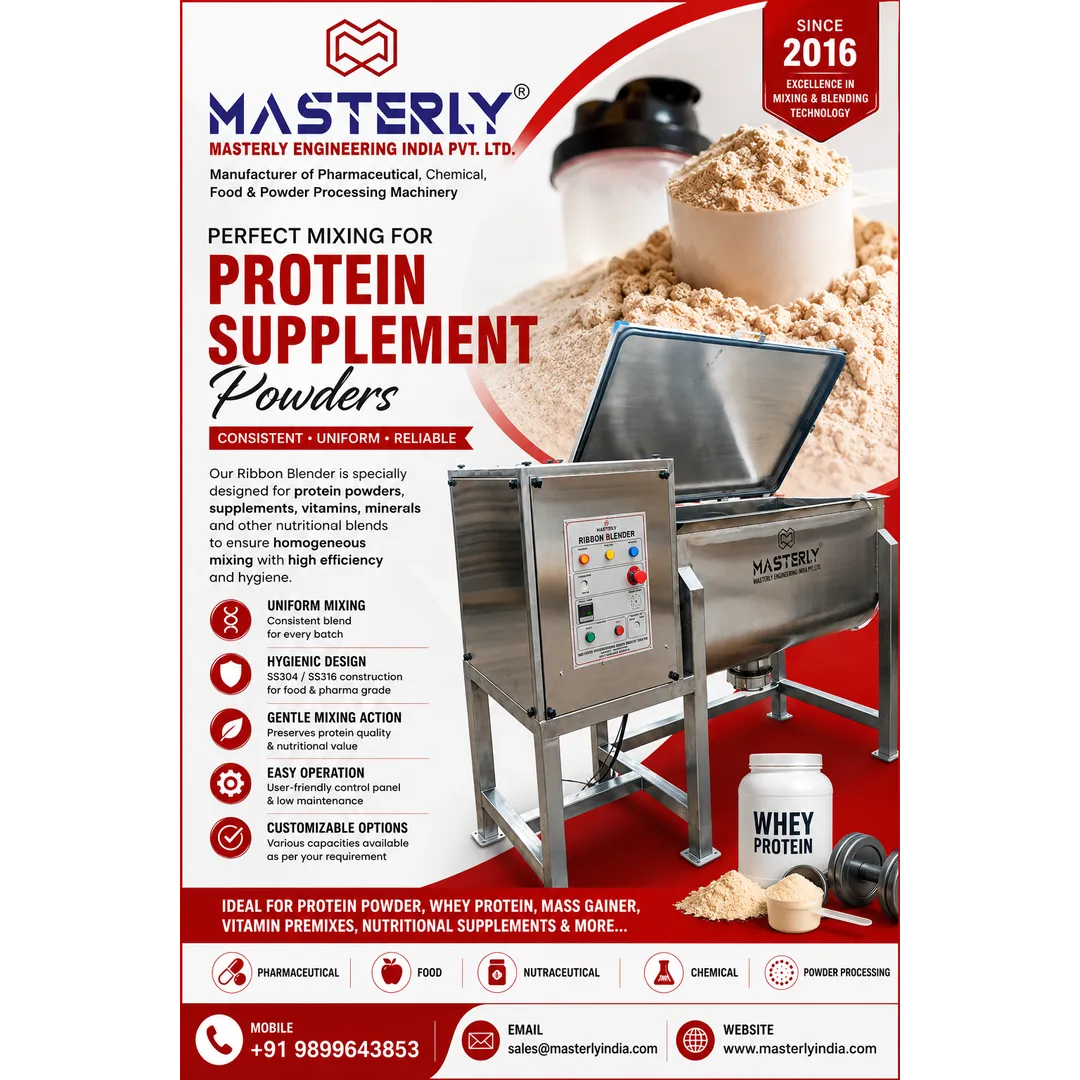
B. Ribbon Blender – good for larger production
Suitable when:
- Batch size is large
- Powder has moderate cohesiveness
- You need faster mixing
- Recipe contains several different powder ingredients
For pharmaceutical/nutraceutical applications, an SS316 contact-part Ribbon Blender with suitable internal finish can be specified.
C. Paddle/Plough Shear Mixer
Consider this when the protein formulation is:
- Highly cohesive
- Difficult to flow
- Contains sticky ingredients
- Requires stronger mechanical mixing
3. Very important: calculate by volume, not only kg
For example, if your batch is 100 kg and bulk density is 0.4 kg/L:
Required powder volume = 100 ÷ 0.4 = 250 L
If the recommended filling level is around 50–60%, you may need approximately a 400–500 L blender, rather than a 250 L machine.
4. For protein supplements, I would specify
- Contact parts: SS316
- Internal finish: preferably Ra ≤ 0.4–0.8 µm depending on GMP requirement
- Mirror-polished internal surface
- No product-trapping pockets
- Easy-clean design
- Suitable bottom discharge
- Dust-tight cover
- Proper earthing
- VFD-controlled motor
- Sampling arrangement if required
- Optional CIP/WIP provisions
- Food/pharma-grade seals
- Load-cell weighing if automated batching is required
5. Best choice by application
Whey protein + flavour + sugar → Octagonal Blender
Large-volume protein powder production → Ribbon Blender / Octagonal Blender
Protein + vitamins/minerals in small quantities → High-uniformity Octagonal Blender with controlled mixing
Sticky/cohesive protein formulation → Paddle or Plough Shear Mixer
If you give me batch size (kg), bulk density, ingredients, and required mixing time, I can calculate the exact mixer capacity, working volume, motor HP, RPM, and recommended mixer type for your protein supplement application.
Keywords