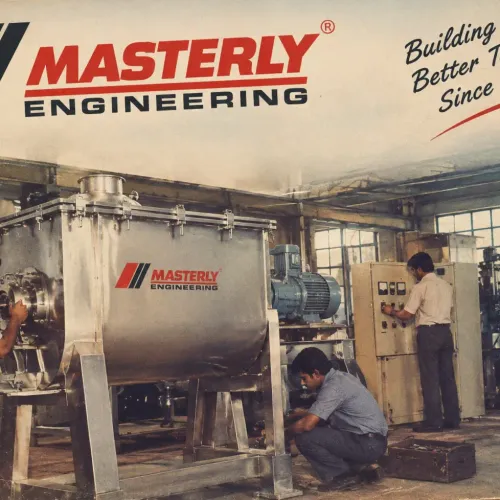

The Dye Penetrant Test (DPT) — also known as Liquid Penetrant Test (LPT) — is a non-destructive testing (NDT) method used to detect surface cracks, porosity, or weld defects in stainless steel (SS) parts of a Ribbon Blender.
Here’s a clear explanation for you 👇
🔧 Purpose of DPT in Ribbon Blender
In a pharmaceutical-grade Ribbon Blender, the internal surface and weld joints must be smooth, defect-free, and hygienic, as any microcrack or porosity can:
- Trap powder or moisture,
- Cause bacterial growth,
- Lead to contamination, and
- Reduce the structural strength of the vessel.
So, DPT ensures all welds and polished surfaces (especially SS304 or SS316) are free from cracks and surface discontinuities.
🧪 How the DPT Process Works
The test is performed in several steps:
- Surface Cleaning:
- The stainless steel surface (especially around welds) is cleaned thoroughly to remove grease, oil, dust, or other contaminants.
- Application of Penetrant:
- A visible red dye or fluorescent dye penetrant is applied evenly on the surface.
- It seeps into any surface cracks or pores.
- Dwell Time:
- The penetrant is left for 10–30 minutes to allow it to enter surface defects.
- Excess Penetrant Removal:
- The surface is gently wiped and cleaned with a remover so that only the penetrant inside defects remains.
- Developer Application:
- A white developer spray is applied.
- It acts like a blotter — pulling out dye trapped in defects, making them visible as red or pink lines/spots.
- Inspection:
- The surface is inspected visually under white light (for visible dye) or UV light (for fluorescent dye).
- Cracks, porosity, or pinholes appear as clear colored indications.
- Post-Cleaning:
- The component is cleaned again after inspection, ensuring no residue remains.
📋 Where DPT is Done in Ribbon Blender
- Weld joints of the inner shell
- Ribbon and shaft welds
- End plate welds
- Nozzle or manhole weld joints
- Any area requiring GMP-grade surface finish
✅ Acceptance Criteria
- No visible cracks, pinholes, or surface discontinuities.
- Surface must be smooth, uniform, and free from defect indications.
📘 Applicable Standards
- ASME Section V, Article 6 (for NDT)
- IS 3658:1981 — Code of practice for Liquid Penetrant Inspection
- GMP & FDA guidelines for sanitary equipment
Keywords