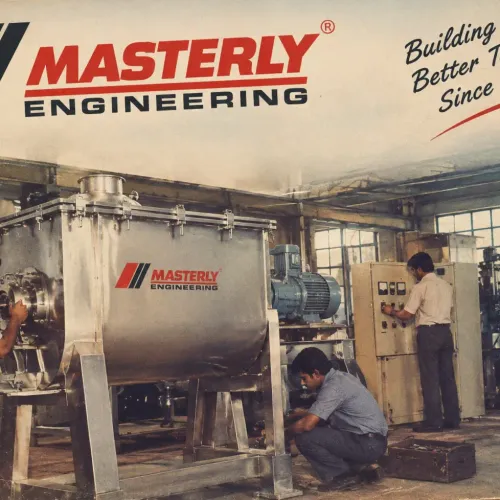

A ribbon blender is a type of industrial mixing machine widely used in pharmaceutical, food, chemical, plastic, and cosmetic industries for mixing powders, granules, and sometimes low-viscosity pastes or slurries.
It is especially known for its fast, efficient, and uniform mixing of bulk materials.
Construction of a Ribbon Blender
- Trough (U-shaped shell): Holds the materials to be mixed.
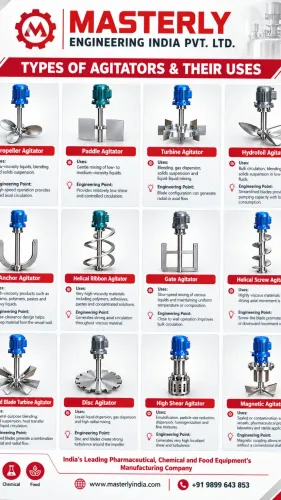
- Ribbon agitator: Consists of two helical ribbons (inner and outer) mounted on a central shaft.
- The outer ribbon moves material in one direction.
- The inner ribbon moves material in the opposite direction.
- Motor and gearbox: Provide power for rotation.
- Discharge valve: For unloading mixed material.
- Cover / safety guards: For safe operation and dust control.
Working Principle
The ribbon blender works on the principle of convective mixing, where material is continuously moved in opposite directions.
- Loading: Raw materials (powders, granules, or small solid particles) are loaded into the U-shaped trough.
- Agitation:
- The outer ribbon pushes materials from the ends of the trough towards the center.
- The inner ribbon pushes materials from the center towards the ends.
- This counter-flow movement ensures thorough mixing.
- Shearing & Layering: As materials move in opposite directions, layers are cut and folded repeatedly, creating a homogeneous blend.
- Discharge: Once mixing is complete, the bottom discharge valve is opened, and the blended material is collected.
Key Features
- Handles large volumes of dry solid materials.
- Gentle yet effective mixing (does not damage fragile ingredients).
- Can be fitted with jacketed design for heating/cooling.
- Typically achieves uniform mixing in 15–20 minutes.
A ribbon blender is a U-shaped horizontal mixer with a helical agitator that moves materials in opposite directions, achieving quick and uniform blending of powders and granules.
Keywords