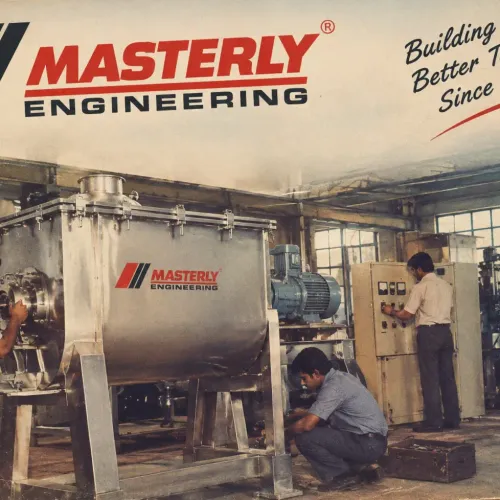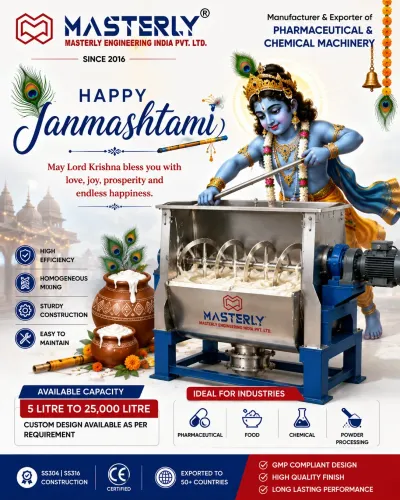

Design options — Ribbon Blender (Masterly Engineering)
1) Basic machine choices
- Single-shaft ribbon blender — standard for dry powder & dry-mix duties.
- Double-shaft ribbon — higher throughput, faster mixing for denser/high-viscosity products.
- Octagonal / U-type trough — U-trough for easy discharge; octagonal for reduced dead zones and better flow.
- Vertical ribbon blender — for very small footprints or dense products (special applications).
2) Capacity & geometry
- Capacity range: pilot (10–50 L) → lab (50–500 L) → production (0.1–10 m³ and up).
- Trough shapes: round-bottom (simple), U-shaped (common), octagonal (better mixing, less dead space).
- Length-to-diameter ratio — specified per capacity & product to achieve target homogeneity in target cycle time.
3) Materials & finish
- Standard: SS304 (for most food/chemicals).
- Hygienic / pharma: SS316L (product-contact), electropolished interior (Ra ≤ 0.6 µm or as requested).
- Food grade: food-safe welds, radiused corners, no dead pockets.
- Heavy duty: carbon steel with protective coatings (for non-food industrial applications).
4) Ribbon & internal design
- Single or double concentric ribbons (outer reverse + inner forward) for gentle, efficient axial & radial mixing.
- Scraper ribbons / paddle scrapers — to minimize material sticking and aid discharge (useful for sticky powders).
- Segmented ribbons / variable pitch — tailored to material flow properties.
- Baffle inserts / lifters — for powders prone to channeling or for improving vertical circulation.
- Internals surface finish options — polished, ground, or as-welded depending on application.
5) Discharge options
- Manual butterfly valve (with handle) — simple, low-cost.
- Pneumatic actuated butterfly / slide valve — for automation and remote operation.
- Bottom-door quick-release — for fast batch changeover.
- Rotary valve (airlock) — for controlled discharge to downstream pneumatic conveying.
- Vacuum discharge / vacuum-assisted loading — for degassing or removing entrained air.
6) Shaft sealing & bearings
- Lip seals — economical for many dry applications.
- Mechanical seals — for more hygienic or sanitary requirements and to reduce leakage.
- Double-seal with barrier — for critical pharma applications.
- External bearings with splash guards — accessible maintenance.
- IP-rated covers where washdown required.
7) Drive, gearbox & motor
- Direct-coupled helical gearbox — common, reliable.
- V-belt drive — for simpler, lower-cost installations (less common on larger units).
- Variable Frequency Drive (VFD) — speed control for gentle start, optimized mixing, and soft-start to reduce product segregation.
- Motor options: TEFC, explosion-proof (ATEX/IECEx), stainless-steel motor housings (pharma).
- Torque & power sizing — sized by batch capacity, bulk density, and mixing intensity (we can provide exact motor sizing after product data).
8) Heating / cooling & jackets
- Full jacket (steam, hot oil, or thermal fluid) — for heating or cooling the product.
- Half-jacket or coil — alternate option for retrofit or lower cost.
- Internal coils — for more intimate heating/cooling in viscous mixes.
- Temperature sensors / thermowells — for process control.
9) Loading & feeding
- Top manhole / product inlet — plain or vibrated.
- Feeders: screw feeder, vibratory feeder, loss-in-weight feeders.
- Vacuum loaders or pneumatic conveyors — for dust-free transfer.
- Multiple inlets for liquids, powders, or granules.
10) Controls & instrumentation
- PLC with HMI — recipe control, timers, alarms, logging.
- Loadcell-mounted base — batch weighing and automated batching.
- Level sensors, temperature probes, and product homogeneity sensors (if requested).
- Remote monitoring / Industry 4.0 integration optional.
11) Sanitary & cleaning features
- CIP (Clean-in-Place) nozzles and drains — for frequent cleaning requirements.
- Quick-release inspection ports — easy access for manual cleaning and inspection.
- Electropolish & crevice-free welds — for GMP compliance.
- Gasket materials — FDA-approved silicone, EPDM, Viton as per product compatibility.
12) Filtration, dust control & containment
- Bag filter / pulse-jet collector — for dust-laden discharge or dust control during loading.
- Enclosures with extraction ports — to connect to plant ventilation.
- Negative-pressure designs for hazardous dust containment.
- ATEX/IECEx certified design for combustible dust atmospheres.
13) Safety & compliance
- Safety interlocks on access doors / manholes.
- Emergency stop & guards for rotating parts.
- Ergonomic access platforms and ladders.
- Certifications available: CE, ISO 9001, GMP-compatible documentation, FAT/SAT, material certificates (MTC).
- Surface roughness and weld documentation for pharma/food audits.
14) Special options / add-ons
- Vacuum / inert gas purging (N₂) — for oxidation-sensitive products.
- Liquid injection ports / spray nozzles — for liquid addition during mixing.
- Vacuum de-aeration / deaeration blades — to remove entrapped air.
- Inline milling / chopper — for agglomerate break-up (integrated or downstream).
- Mobile base with casters — for flexible production lines.
- Modular skid with downstream conveyors, sieves, or packaging integration.
15) Typical spec table (example)
- Model: MRE-RB-200 (example)
- Capacity: 200 L (batch)
- Trough: U-shaped, SS316L, electropolished (Ra 0.6 µm)
- Drive: 3.0 kW motor + helical gearbox + VFD
- Seals: double mechanical seal (barrier)
- Discharge: pneumatic-actuated butterfly valve
- Options: Loadcells, PLC + HMI, CIP nozzles, jacket for hot water circulation
Industry-specific recommendations
- Pharmaceuticals: SS316L, electropolish, CIP, double-seal, GMP documentation, HEPA-filtered vents.
- Food: Food-grade gaskets, polished finish, dust control, NSF/FDA compatibility where required.
- Chemicals: ATEX options, mechanical seals, jacketed heating/cooling, robust coatings.
- Fertilizer / Heavy duty: Carbon-steel with abrasion-resistant liners and heavy-duty drives.
Keywords